My Personal Experience of a T-group
My Interest in T-groups
I was interested in groups pretty early in my coaching journey. Around 8 years ago I read everything that was available about group coaching* but I didn’t really find out about T-groups until around 2 years ago and mainly through the work of Carl Rogers**. He wrote a book ‘On Encounter Group’ and was featured in the documentary demonstrating the work of an encounter group called ‘Journey Into Self’. Later my interest deepened by an amazing ‘The Theory and Practice of Group Psychotherapy’ by Irvin Yalom*** and Molyn Leszcz, not necessarily a book about T-group but bearing some similarities in spirit.
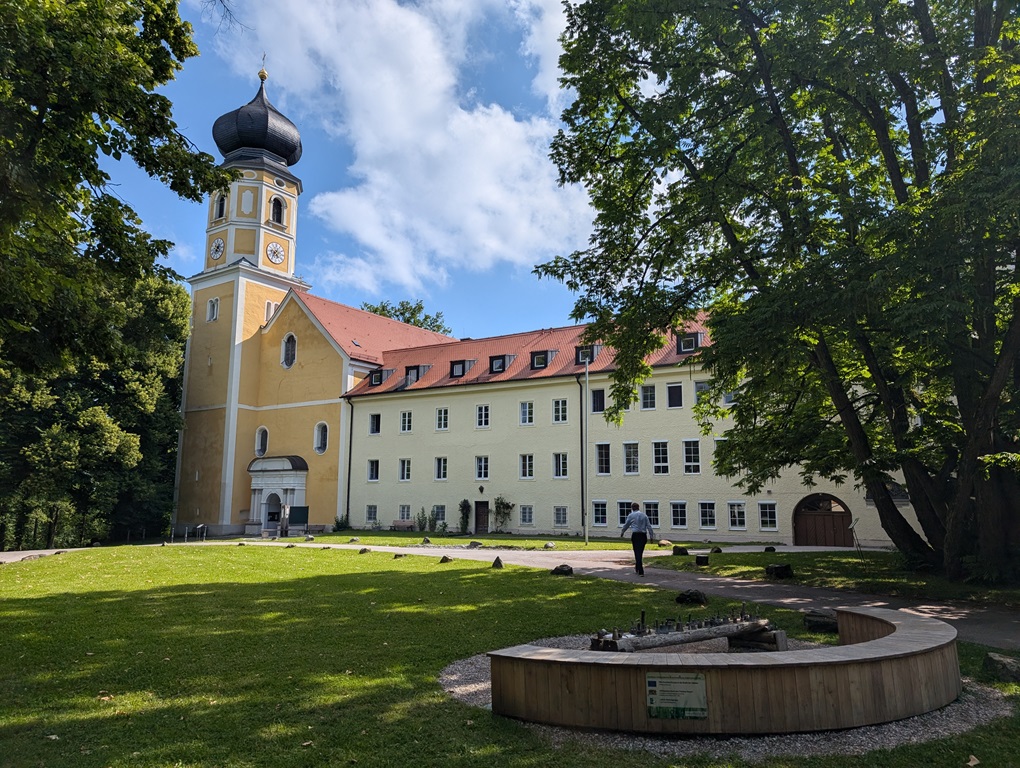
So from there, I started looking for opportunities to experience a similar group process. That search led me to a T-group organized by DGGO‘s Monika Stützle-Hebel (DGGO stands for German Society for Group Dynamics and Organizational Dynamics) led by Gilmore Crosby in a small Bavarian town near Munich which was a fairly simple trip from Prague.
Let me give you just the briefest possible summary of what T-group is (for longer and much more knowledgeable ones check out this article by Ed Batista and one from Crosby & Associates). Training group or T-group grew from a discovery made by Kurt Lewin and his associates. While they were running a seminar to address the interracial issues in the US in the 40s some seminar participants joined the faculty’s evening debriefing sessions and then started actively participating in the discussion reflecting on their own process. These elements of the group process combined with reflection by the members from within the process became key for T-groups. The idea behind it was that the participants of the process, the learners themselves are the best equipped to discuss the process they are experiencing. In Lewin’s words, ‘we should consider action, research, and training as a triangle that should be kept together.’
One important note is that there seems to be a difference in how T-groups are run by Crosby & Associates and elsewhere. What I understood is that Crosby’s version is a more traditional way stemming from how they were done in the 50s and consisting of a mixture of training and group process. Whereas in a more widespread format, there is only a group process and no training delivered by a T-group facilitator. German group dynamics scholar Klaus Antons was observing our T-group and will be writing an article on the differences between this approach and the one traditionally practiced in Germany.
Structure and the Process of a T-group****
The T-group ran from Monday to Friday. On Monday we started at 11 am. On Friday we ended at 2:30 pm. On other days we worked from 9 am to 6 pm with a two-hour lunch break. 14 people participated in the workshop. Only one was a native English speaker. For the majority, German was their first language.
Our activities consisted of theoretical modules, reflection in pairs, small T-groups, full-group discussions that gradually morphed into T-group in the middle of the week.
After a welcome from the workshop organizer and brief introductions from the participants, Gilmore made an introduction to Lewinian social science and talked about the invention of T-groups, and covered the logistics of the workshop. From time to time, he made breaks for reflection in pairs. The prompt for reflection was: ‘What does it mean for you?’
In the afternoon we had our first T-group experience. Here’s how it was structured. The participants were divided into two groups of 7. The way they were formed is Gilmore simply said, “I need 7 of you to be in the center circle.” And then we organized the groups. We stayed in the same groups (except for minor changes for example when someone needed to leave the workshop earlier for personal reasons) for the rest of the week.
Group A sat in the circle and interacted for 10 minutes. Individually, for all in Group A the task was to talk about what we want, think, and/or feel—here and now. We could also share our observations about the group dynamics.
Each member of Group A was partnered with an observer from group B (we stayed in these pairs for half of the week and then we were paired with another person from a sister group). Observers sat in an outside circle. Their task was to pay attention to and as much as possible write down everything a participant said verbatim, plus the participant’s body language, tone of voice, and hunches about what was happening with them. After 10 minutes spent in the T-group, participant debriefed with their observers for 5 minutes. Observers were to start with what they consider the most important and impactful moment from the 10 minutes in the T-group and from there observer’s job was to help the participant reflect.
After debriefing, group B sat in the circle and the cycle repeated. During a typical day, we would have around group A and group B would have 4 10-minute T-group each.
I will try to describe, in a more general manner, what was happening in such a 10-minute T-group. And then I will write more about my subjective experience of it and my biggest takeaways.
10 minutes is such a short interval that it creates unexpected immediacy. Our agenda was to talk about wants, feelings, and thoughts and for 7 people it is not enough time, to say at least. Different people react differently to such a context. Some withdraw, some talk more, some wait for the right moment to talk. From time to time Gilmore would interject, usually to clarify what a speaker or person the speaker addressed feels. But sometimes also to ask what’s going on with a quiet participant. All in all, even if one is quiet for the whole 10 minutes it’s an experience rich for reflecting and learning.
There were several guidelines related to work in T-groups that Gilmore invited us to follow. He introduced them gradually and in response to what was happening.
— The first one was about addressing one specific person rather than the group as a whole. Otherwise it could mean some avoidance. And even if we want to say something about the group as a whole we can talk to a specific person and that others will hear what we have to say.
— Another one was about being more precise with expressing emotions. For example, ‘I’m curious’ is not precise enough. What’s behind curiosity? Is one worried, concerned, frustrated?
— The third thing, and Gilmore said that his father was stricter about this, was about not talking about the stuff that happened in T-group outside of T-group. It was more like an invitation. If we can wait, it’s better to wait and address it within the group. But if we need to address something right away it was also fine for us to do it.
In addition to working in T-groups from time to time Gilmore delivered short theoretical modules. A bit more in the beginning especially on day 2 and gradually less and less. Among the topics covered were: Tukman’s model, John Wallen’s interpersonal gap, emotional intelligence, Bowen’s systems theory, Jay Hall’s conflict styles. At least once, it seemed that Gilmore decided to quickly describe Karpman’s triangle as an ad hoc response to something he observed during one of the T-groups.
How we T-group’ed
Now I want to share a few subjective experiences to demonstrate what is possible within such a structure (of course without disclosing any personal details of the participants).
Group dynamics
The very first 10-minute T-group for me was like leaping into the unknown. I immediately noticed my thought process. Should I speak? Should I stay silent? The majority of the participants had previous experience with T-groups, and some had significant experience. Half-consciously I decided that perhaps it’s safer to first see what these more experienced people will do. While I was mulling these things over, some conversation started and then I wasn’t comfortable about interrupting or interjecting and I stayed quiet almost all the time. First lesson, take care of yourself. It’s one’s personal responsibility to talk about one’s needs. Yes, sometimes people may inquire or invite you to participate but too much waiting or doubting is not going to serve one well.
The few of the next T-groups I spent calibrating my participation. How can I show up fully but also don’t take too much space from others? My first few tries to participate were quite jerky: waiting for the ‘right’ time to speak up, throwing in a few sentences, and stopping. Someone even said that they would like to hear more from me once I start talking. In other words, I became more aware of how cautious I was, thinking about whether I would be accepted, thinking about what is allowed here and what is not. The first day to day and a half, I spent adapting, safely experimenting, and blending in.
Differentiation
And actually the morning of the second day Gilmore spent some time talking about the Tukman model. It was extremely relevant to reiterate it while we were all going through that very process. The biggest takeaway from Gilmore’s explanation of this model for me was that the more appropriate name for the ‘storming’ stage would be ‘noticing differences.’
Noticing differences was one of my biggest learnings. It started when we had a change in our T-group. The members were swapped. Participant X in our group voiced her dissatisfaction with the way it was done and about the fact that we as a group were not consulted. A conversation about that ensued for a while. And then I said that I was a bit frustrated about all this drama. And that in my opinion it’s not that much of a deal at all and we just need to move on. Our T-group round ended. And then we had another one where we continued to talk about this topic. And it started dawning on me.
Describing an insight in words rarely does justice to its profundity. It may look too obvious to hold any significance. But for me it was deep. What happened is that I realized that ‘not a big deal’ is just my opinion. But this opinion seemed so ‘right.’ I was ‘right’ about the fact that we don’t need to discuss that matter. And then I realized that it’s just my opinion. I don’t have a need to discuss it but others might have that need and having that need doesn’t make them ‘wrong.’ I noticed how believing in my being so smart can fool me into thinking I know what’s ‘right.’ Once I had that insight I also realized that I have a lot of admiration for people who continue to speak up about their needs even when not everybody recognizes these needs.
I also had an experience that exemplified the same dynamics in reverse. At one point, one person had strong emotions and the group continued with other things. I said that I was frustrated that we were ignoring someone who potentially needed help at the moment. We discussed it a bit and found a good way to wrap it up. Then the next day something similar happened. On separate occasions, two people experienced strong emotions and the group continued with other things. At some point in a group discussion, I said to Gilmore that I didn’t like it and that I wanted to establish a rule that if someone is experiencing strong emotions we need to stop and check whether they need help. I felt quite righteous about that and was frustrated that the group didn’t see it the way I saw it. Gilmore responded that he would prefer if everyone would speak up when they need something and that he rather not set up the rules that I suggested. That argument made sense to me and I agreed. And overall, to my surprise, the majority of the people didn’t have that need to ask others how they felt and whether they needed anything. And it was another realization for me that it was just my need and it was not the ‘truth’ that we need to do it that way. Understanding how it was for others, I calmed down and also said that if others don’t need it, I’m going to do it on my own, if I see strong emotions again.
Dealing with authority
One of the great aspects of T-group is that embedded in it is a relationship with authority that can provide interesting insights. At the beginning of the workshop, Gilmore share that speaking up to the authority figure is an important part of the T-group process is and that if we notice that we are unhappy with him, he would like us to tell it to him.
I already described my smallish disagreement with Gilmore above. A bigger one happened when Participant Y started a conversation about changing how we structure our work. At first, he only aksed a question about when it would be a good time for us as a group to discuss such matters. But slowly it slipped into the discussion. Participant Y’s main point was about having longer rounds for T-groups. Gilmore said something like ‘I prefer that you each find your own path on this. Speaking up and saying what you want is not dependent on the amount of time you have.’ For Participant Y that wasn’t enough so he continued that discussion with Gilmore. The upshot was that we continued with the same timing for T-groups. But what was striking about that discussion is how unconfrontational it was.
It’s a bit of a puzzle for me at this point but there was something in Gilmore’s group leadership style that made this and other disagreements very amiable even when some emotions were there. I’m not fully sure how he did it because I was too absorbed by my own process. But there were at least two behaviorally specific things I noticed that I think contributed to our psychological safety. First, is that from time to time when someone confronted Gilmore he preambled his response with ‘I notice that I’m becoming defensive.’ Second, when he used his authority to say ‘no’ to someone’s request he also often added ‘I liked that you asked for it.’ Both were used extremely genuinely and not as a manipulative tool.
My biggest takeaways
What I noticed is that immersing myself in 5 days of intense relational and reflective space was highly conducive to generating insights. Sometimes they came up during our sessions, sometimes during lunchtime or evening beers.
Here are my most valuable insights:
1) One of my patterns is to call, inside of my head, things or people stupid. Someone didn’t read a book I consider basic, they are stupid. Someone raised a topic I consider not relevant, it’s stupid. This thing is a huge obstacle for me to connect with people more deeply. And the new insight that I got was that by calling something or someone stupid my brain resolves emotional tension. In reality, it’s not ‘you are stupid’ it’s ‘I’m frustrated’ or sometimes ‘I’m afraid.’ My new practice is when I notice my ‘stupid’ self-talk to connect to the emotion behind it and to try not to resolve it right away.
2) This one I already mentioned but I’ll add more color. Because my brain thinks it’s so smart it often makes me think that I know what’s going on and that I know what’s right and what’s useful. Because of that I can overlook other people’s needs or ignore other people’s emotions. I’m quite sensitive to what others feel but I still can misinterpret what exactly it is because I would rely on my head too much. My takeaway is that I need to check in more often and clarify what others need. Related to that, the difference between my needs and other people’s needs is not a problem, often it doesn’t need much more than just acknowledging the difference and, of course, this difference doesn’t mean that they are ‘stupid.’
3) I read a lot. I love ideas. And my brain is fascinated by making connections between ideas. The bad habit I developed is trying to connect to other humans by showing them how much I know and how smart I am. Of course, it doesn’t work. My third biggest insight is that when someone says something about which I know more, my urge to flaunt my erudition is a disguised desire to connect. So instead of sharing what I know, what I can do is share the deeper process in me. For example, I can say ‘I like it’ or let them know that I like them or that I value my relationship with them.
Conclusion
Even though I expected the whole thing to be great, experiencing it turned out to be even greater. When it finished I regretted that I didn’t invite people to join me. I realized that I know so many people who could have benefited from it. Honestly, I don’t know anyone who would not have benefited from it.
At the moment, there are at least several outcomes I’ve got from this workshop. Firstly, I increased my self-awareness and got ideas about what I can do to grow as a human. Secondly, I experienced a lot of camaraderie, connection, and love. Thirdly, for many years I wrote off training as an extremely inefficient form of learning, thinking of it as almost like corporate entertainment, and now I recovered some hope in it because I see ways to run it differently and more experientially. And finally, I also developed a deeper interest in this type of work. Before I had only distant theoretical admiration based on books that I read. Now, I want to explore it more and maybe even someday run T-groups on my own.
For those who would be interested in learning more about T-groups you can read Gilmore’s ‘Planned Change: Planned Change: Why Kurt Lewin’s Social Science is Still Best Practice for Business Results, Change Management, and Human Progress’ and Robert Crosby’s ‘Memoirs of a Change Agent: T-groups, Organization Development, and Social Justice’
—
*Among the books on group coaching, I like Christine Thornton’s ‘Group and Team Coaching: The Secret Life of Groups’ the most. She also had background group analysis. Which as far as I can tell also has some similarities with the T-group process.
**Even though he was writing about encounter groups, it seems that some people use these terms interchangeably while others use them to emphasize differences in these groups. My interpretation is that they describe an inherently similar process. And also Rogers was not foreign to the T-group movements as he was also participating in activities organized by the NTL Institute, an organization where T-groups were first developed and refined as a process.
***Yalom also, with Morton Lieberman, ran research on encounter groups and published it in the early 70s as ‘Encounter Groups: First Facts.’ It was fairly critical, mostly due to the fact that most group leaders didn’t possess enough skills and were trying to make the whole process too confrontational and cathartic.
****Gilmore was generous enough to review my draft and provided some revisions. If there would be still some inaccuracies they are solely my fault.